Before you choose
What you need to know about this experience
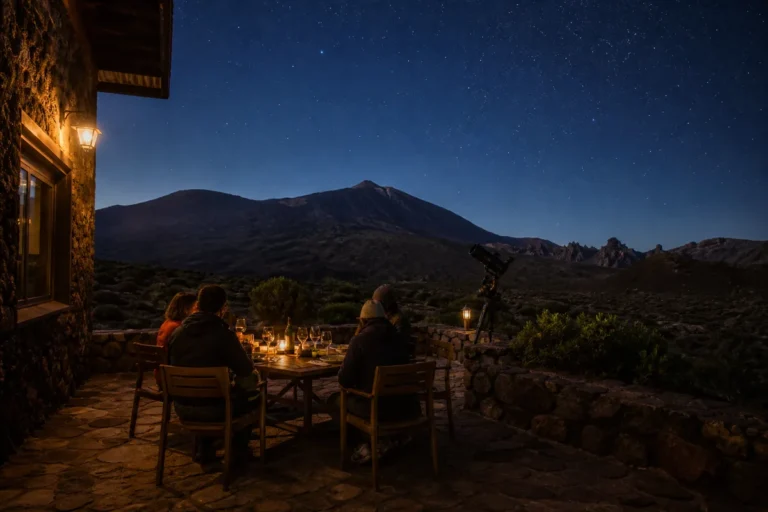
A Teide sunset and stargazing hike combines a late-afternoon guided walk in the national park, the sunset and a look at the night sky once it gets dark. It is for people who want to walk through the landscape, not just see it from a viewpoint.
The name is used on the market for very different things: from a 40-minute stroll to a route of several hours. Here we explain how to tell them apart and what to ask so you know how much you will really walk.
At a glance
| Aspect | What to expect |
|---|---|
| What it is | Guided walk through Las Cañadas + sunset + stargazing |
| How much walking | From strolls of about 40 minutes to routes of several kilometres. Depends on the provider |
| Altitudee | Above 2,000 metres; some options go up by cable car to 3,555 m |
| Timing | Starts mid-afternoon and finishes after dark |
| Permit | The usual routes do not require a permit; the summit does (PNT 10) |
| Observation | With the naked eye, a laser pointer or a telescope. Depends on the provider |
| Cold | Important: the temperature drops quickly once the sun sets |
| Price | Depends on the provider, the format (group or private) and what is included |
What happens
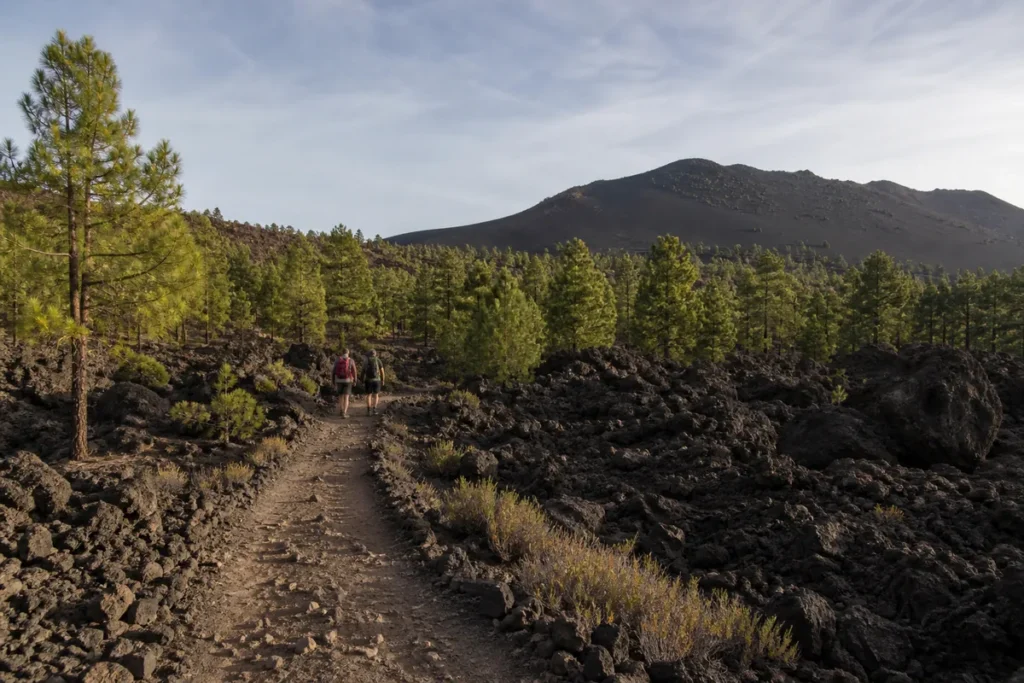
The trip usually starts mid-afternoon, with a pick-up or a meeting point in the park. The guide leads a walk along a trail in Las Cañadas while explaining the geology and vegetation.
The route is timed to reach a spot with a good view at sunset. Then, once it gets dark, the group stops to look at the sky: constellations with the naked eye, sometimes with a laser pointer and, in some offers, with a telescope.
Which routes are usually used
- Roques de García (trail 3): a circular route of about 3.5 kilometres, starting opposite the Parador de Las Cañadas. Turismo de Tenerife describes it as easy. No booking required.
- Short stretches near the Parador or the TF-21 road, chosen by the guide depending on the wind and the light.
- Trail to the Pico Viejo viewpoint, from the cable car upper station, in the options that include a sunset cable car ride. One operator describes it as a walk of about 40 minutes there and back, of low to medium difficulty.
If what you want is to reach the summit, this is not the right product: you need a guided ascent of Pico del Teide with a permit.
Formats and differences
| Format | How much walking | Suits you if… |
|---|---|---|
| Short walk + stargazing | 30–60 minutes at a gentle pace | You want some activity without much effort |
| Sunset hike + stargazing | 2–3 hours, several kilometres | You enjoy walking and are used to it |
| Sunset cable car + walk at 3,555 m + stargazing | Short walk at high altitude | You want the highest sunset and nobody in the group is restricted from using the cable car |
| Private | Whatever you agree | You want to set the pace, route and timing |
If you are not really interested in walking, the closest option is Teide sunset and stargazing.
Where it takes place
Everything takes place inside Teide National Park, in the Las Cañadas area, above 2,000 metres. The most common reference point is the area around the Parador de Las Cañadas and the La Ruleta viewpoint, next to the Roques de García.
If the provider does not include transport, bear in mind that the public buses that go up to the park run during the day and cannot be used to get back at night. For this activity, included transport or your own car is almost essential.
Who it suits
- People who want to walk in the park and not just see it from a vehicle.
- Couples or groups of friends looking for a full afternoon on Teide.
- Hikers who do not need to reach the summit.
- Families with older children who are used to walking and can cope with the cold.
Who it may not suit, and what to weigh up
- Anyone who does not cope well with cold or comes without warm clothing.
- People with heart or breathing problems, because of the altitude.
- Anyone who wants a telescope and a detailed astronomy talk: many hiking trips only include naked-eye stargazing.
- Young children: the activity finishes late. Ask about the minimum age.
- If you take the cable car at sunset, pregnant women, children under 3, people with cardiovascular problems and people with reduced physical or motor mobility cannot ride.
How to choose well
- How many kilometres and how much ascent does the route involve? This is the question that separates a stroll from a real hike.
- Where is the sunset viewed? And what happens if there is cloud or strong wind?
- What is the observation like? Naked eye, laser pointer, telescope? Who leads it?
- What time does it finish and how do you get back? Is return transport included?
- What happens if the sky is overcast? Is the date changed, is the price refunded or does it go ahead anyway?
- Do they lend warm clothing or a head torch?
- Minimum age and maximum group size?
- Who is guiding, and with what accreditation? In the Canary Islands, working as a tourist guide requires authorisation from the Gobierno de Canarias.
What is usually included and what to check
| Item | Usual practice | Check |
|---|---|---|
| Hiking guide | Included | Accreditation and language |
| Stargazing | Included, in different formats | Whether there is a telescope |
| Transport | Included in some offers | Return time |
| Cable car | Only in some options | Whether it is included and plan B if it closes |
| Snack or dinner | Some offers include it | Whether there is a vegetarian or gluten-free option |
| Warm clothing | Some providers lend it | Sizes and quantity |
Safety and requirements
- Altitudee: the whole route is above 2,000 metres. Walk at your own pace and tell the guide if you feel unwell.
- Darkness: the return is usually after dark. Bring a head torch and stay with the group.
- Terrain: volcanic trails have loose stones. Wear closed shoes with good soles.
- Park rules: leaving the marked trails, taking stones or plants, lighting fires and playing loud music are not allowed, according to the national park’s visitor rules.
- Special nights: on very busy dates, such as some meteor showers, the Cabildo has regulated night-time access to the park. Ask the provider whether your date is affected.
Weather, the Moon and time of year
- Cold: the Spanish Ministry for the Ecological Transition points out that the park is high mountain terrain with an extreme climate. After sunset, the temperature drops quickly.
- Wind: it may force a change of route or observation point, and it closes the cable car.
- Cloud and calima: they can cover the sky even when the coast is clear, or the other way round.
- Moon: with a full Moon you see fewer faint stars, but the landscape is lit up. If deep-sky viewing matters to you, choose dates close to the new Moon.
- Sunset time: it changes a lot throughout the year, and so does the start time.
Price: what it depends on
We do not give a reference figure: the offers reviewed combine walking, cable car, dinner and stargazing in different ways and are not comparable.
These factors determine the price:
- Whether transport is included.
- Sunset cable car ride, which adds considerably to the cost.
- Dinner or snack.
- Type of observation: naked eye or telescope.
- Format: small group or private.
What to bring
- Warm layers, a hat and gloves, even in summer.
- Hiking boots or trainers with good soles.
- A head torch or torch, ideally with a red light so you do not dazzle anyone during the observation.
- Water and a snack.
- Sun protection and sunglasses for the daylight part.
Alternatives and how to compare them
| If you are looking for… | Best option |
|---|---|
| Sunset and stars without walking | Teide sunset and stargazing |
| Reaching the summit of Teide | Guided ascent of Pico del Teide |
| Telescope observation for your group only | Private stargazing tour in Tenerife |
| A daytime hike in a different landscape | Guided hiking in Anaga |
Frequently asked questions
How much walking is involved?
It depends a lot on the offer: from strolls of about 40 minutes to routes of several kilometres. Always ask about distance and ascent.
Do you need a permit?
Not for the usual routes in Las Cañadas, such as the Roques de García. Only the summit trail (PNT 10) and the Montaña Blanca trail (PNT 07) require a booking.
Is it very cold?
Yes, it can get quite cold at nightfall, even in summer. Bring warm clothing.
Can you always see the stars?
No. It depends on cloud, calima and the Moon. Ask what the provider does if the sky is overcast.
Is there a telescope?
In some offers, yes; on many hiking trips the observation is with the naked eye or a laser pointer.
Can children come?
It depends on the provider’s minimum age and the distance. Bear in mind the cold and the return time.
Can I go on my own?
You can walk the trails without a permit, but getting back at night requires a car. A guided observation adds an explanation of the sky and, in some cases, a telescope.
Can it be combined with the cable car?
Some options go up by cable car at sunset and walk at 3,555 metres. There are health and age restrictions.