Before you choose
What you need to know about this experience
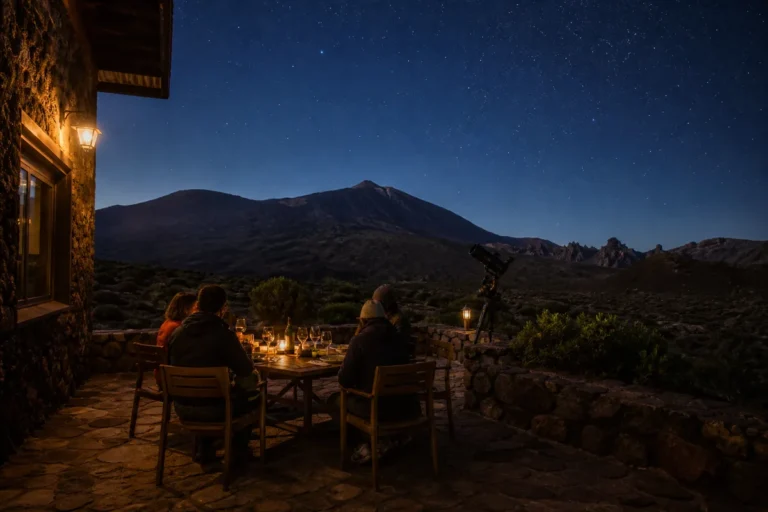
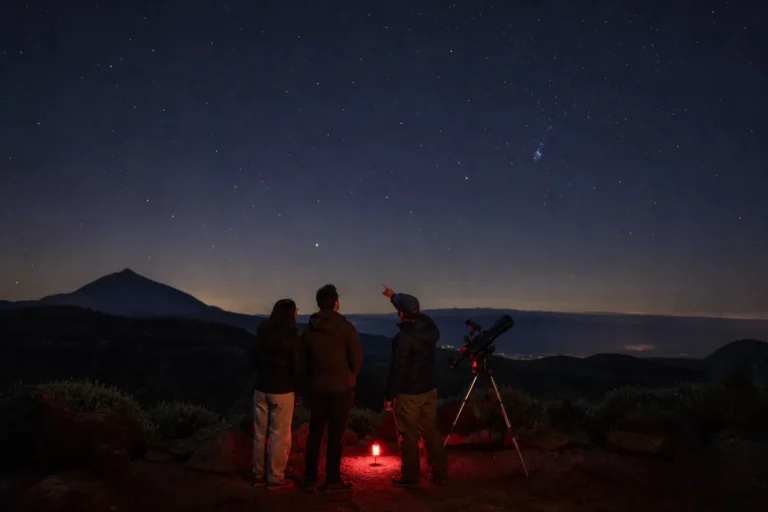
A Teide astrophotography tour is a guided night trip to photograph the sky in Teide National Park, with a specialist guide who helps you choose framing, settings and technique. Depending on the format, you work with your own camera on a tripod or with an automated telescope and an astronomy camera.
It is not the same as a stargazing session with souvenir photos. Here the aim is for you to take the pictures. This page helps you choose a format to suit your equipment and level, and pick a date that is worth it.
At a glance
| Aspect | What to expect |
|---|---|
| What it is | Guided night trip to photograph the sky |
| Formats | Nightscape with your camera; deep sky with a telescope; portrait under the stars; multi-day expeditions |
| Duration | About 4–6 hours in the workshops reviewed. Depends on the provider |
| Altitudee | Around 2,100–2,300 metres |
| Equipment | Camera with manual mode and a tripod for landscapes; for deep sky, the provider supplies the telescope |
| Dates | Close to the new Moon; some workshops are only offered on those dates |
| Group | Small or private |
| Price | Depends on the format, the duration and the equipment the provider supplies |
Which formats exist
| Format | What you do | What you need | Suits you if… |
|---|---|---|---|
| Nightscape workshop | You photograph the Milky Way or the sky with Teide, rock formations or trees in the foreground | Your camera, a wide-angle lens and a tripod | You have a camera and want to learn how to use it at night |
| Deep sky with a telescope | You capture nebulae or galaxies with the provider’s automated telescope and astronomy camera | Interest and patience; the provider supplies the equipment | You are interested in technical astrophotography |
| Portrait under the stars | The guide photographs you with the sky as a backdrop | Nothing | You want a souvenir photo rather than to learn |
| Photography expedition | Several days with day and night outings around the island | Your own equipment and time | You are an advanced enthusiast |
If what you mainly want is to look at the sky, see stargazing in Tenerife or the private stargazing tour.
What happens in a nightscape workshop
- Meeting at a point in the park, usually before it is fully dark.
- Settings explained: manual mode, focusing at infinity, aperture, ISO and exposure time.
- Planning: where the Milky Way will be that night and which foreground to use.
- Guided shooting at one or several spots.
- On-screen review of the results, with corrections.
- Basics of editing, in some workshops.
Common settings in the park include the Roques de García, the Llano de Ucanca and the area around the Parador de Las Cañadas.
What equipment you need
For the nightscape workshop, the providers reviewed recommend:
- A camera with manual mode that performs well at high ISO. Full-frame or APS-C sensors give better results.
- A bright wide-angle lens, around 14–24 mm with an aperture of about f/2.8.
- A sturdy tripod. It is essential: the wind in the park can be strong.
- A remote release or self-timer.
- Spare batteries: the cold drains them fast.
- A head torch with a red light.
You can try with a phone, but results are limited. Ask the provider whether their workshop accepts phones.
Who it suits
- Photography enthusiasts who want to move into night photography.
- People with a camera who have never managed a good shot of the Milky Way.
- Astronomy enthusiasts who want to try deep-sky imaging with professional equipment.
- Couples who want a photor ader the stars, in the simplest format.
Who it may not suit, and what to weigh up
- Anyone who lacks patience: astrophotography means waiting, repeating shots and putting up with the cold.
- Dates close to the full Moon: the Moon lights up the sky and greatly reduces the contrast of the Milky Way.
- Young children: long, cold night sessions.
- People with heart or breathing problems: consult your doctor because of the altitude.
How to choose well
- Exactly which format is it? Landscape with your camera, deep sky with a telescope, or portrait.
- What level is needed? Do you need to know how to use manual mode?
- What equipment does the provider supply? Do they lend a tripod or camera?
- How many participants per guide?
- Which dates are offered? A good workshop is scheduled close to the new Moon.
- Does it include editing, or do they send you the files? For deep sky, ask in what format the images are delivered.
- What happens if there is cloud or calima?
- Who is guiding? Ask about their astrophotography experience, their Starlight accreditation if they have one and their guide licence.
What is usually included and what to check
| Item | Usual practice | Check |
|---|---|---|
| Specialist guide | Included | Night photography experience |
| Technical explanation | Included | Level |
| Telescope and astronomy camera | Deep sky only | What you take home |
| Tripod loan | In some offers | If you are not bringing your own |
| Transport | Rarely included | How to get there at night |
| Editing | In some offers | Whether it is included |
Rules and safety
- Drones: the national park regulates filming, and the area around the observatories is protected airspace. Do not count on flying a drone.
- Professional or commercial use: photo or video productions for commercial purposes in the park require authorisation from the park authority.
- Light: use red light and avoid switching on white torches near other photographers or stargazing groups.
- Do not leave the permitted areas to find a composition.
- Cold and altitude: it can be very cold at night, even in summer.
- Night driving: if you go on your own, check the road conditions before driving up.
The Moon, the Milky Way and time of year
- New Moon: this is the decisive factor. Some deep-sky workshops can only be booked a few days before and after the new Moon.
- Milky Way core: from the Canary Islands it is visible roughly from spring to autumn, at different times depending on the month: in the early hours at the start of the season and at nightfall towards the end.
- Winter: the Milky Way is fainter, but there are very photogenic constellations and long nights.
- Cloud and calima: check the forecast the day before. The park can be clear while the coast is overcast, and the other way round.
Price: what it depends on
We do not give a reference figure: the formats reviewed are very different from each other (portrait as an add-on, a workshop of several hours, deep sky with professional equipment or multi-day expeditions).
These factors determine the price:
- The format and duration.
- The equipment the provider supplies.
- Small group or private.
- Transport and editing.
What to bring
- Camera, wide-angle lens, tripod and remote release.
- Spare batteries and memory cards.
- Winter clothing, a hat and thin gloves for handling the camera.
- A head torch with a red light.
- A flask with a hot drink.
Alternatives and how to compare them
| If you are looking for… | Best option |
|---|---|
| Looking at the sky through a telescope without taking photos | Stargazing in Tenerife |
| A private night with a souvenir photo | Private stargazing tour in Tenerife |
| Sunset and stars with transport | Teide sunset and stargazing |
| Dark skies without going so high | Stargazing in the Barranco de Badajoz |
Frequently asked questions
Do I need a professional camera?
For the nightscape workshop you need a camera with manual mode and a tripod. In deep-sky formats, the provider supplies the telescope and camera.
Can it be done with a phone?
You can try basic photos, but the result is limited. Ask whether the workshop accepts phones.
When is the best time of year to photograph the Milky Way?
From the Canary Islands, the core is visible roughly from spring to autumn. Always choose dates close to the new Moon.
How long does a workshop last?
The nightscape workshops reviewed last between 4 and 6 hours.
Can I fly a drone?
Do not count on it. The park regulates filming, and the area around the observatories is protected airspace.
What happens if it is cloudy?
It depends on the provider. Ask about date changes or refunds.
Do I keep the photos?
In the landscape workshop, you take them yourself with your camera. For deep sky, ask in what format the files are delivered.
Do I need previous experience?
Not for the basic format, but it helps to know how to use your camera in manual mode.