Before you choose
What you need to know about this experience
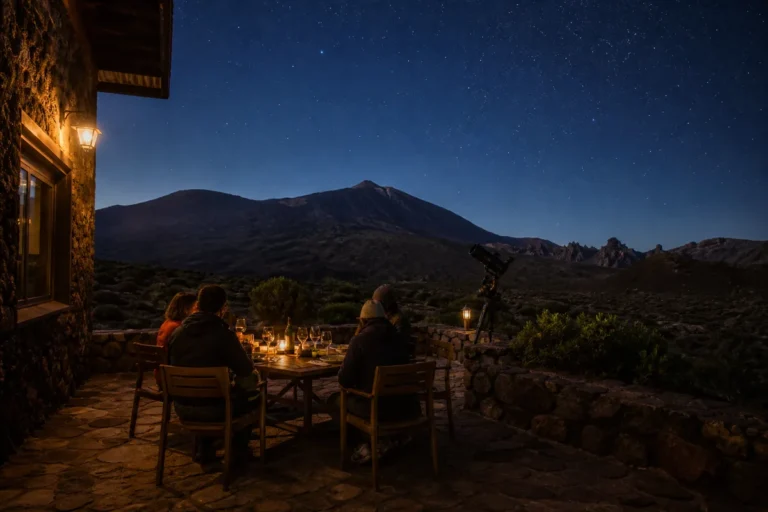
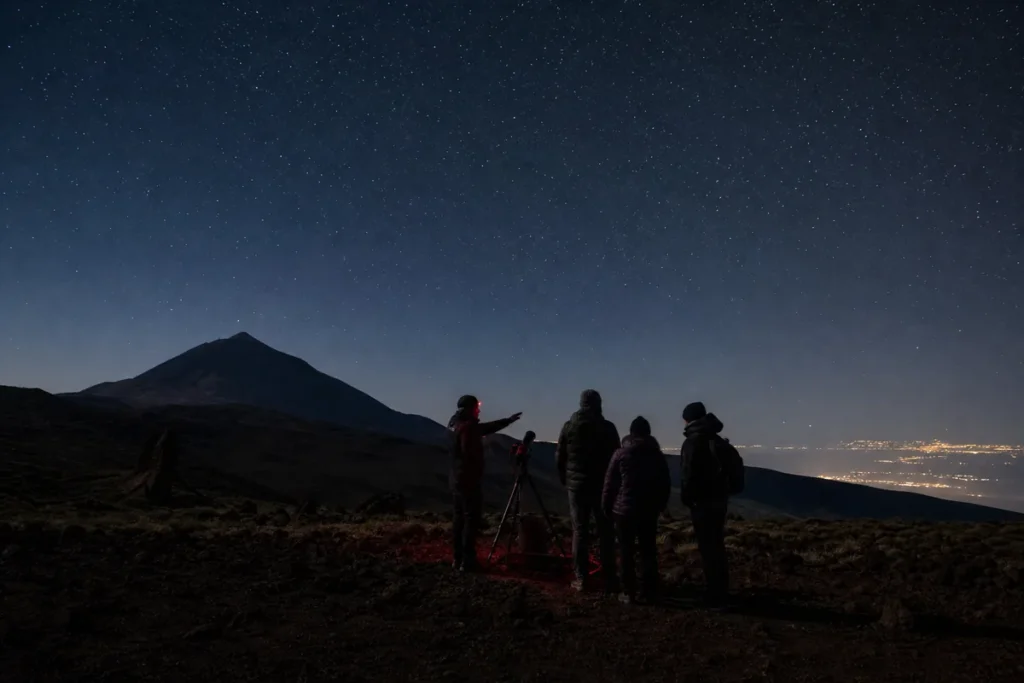
Stargazing in Tenerife means a guided night-time session in which a specialist explains the sky with the naked eye and, usually, through telescopes. Most take place in Teide National Park, above the sea of clouds, although there are other dark spots on the island.
This page covers sessions focused on the sky, without sunset or dinner as the main feature. It helps you choose the format, place and date to make the most of your observation time.
At a glance
| Aspect | What to expect |
|---|---|
| What it is | Guided night-sky observation session |
| Where | Mainly in Teide National Park; also at other dark spots |
| Session length | From a little over an hour to several hours. Depends on the provider |
| Transport | Some offers use a meeting point; others include pick-up |
| Equipment | Laser pointer and telescopes; some add astrophotography |
| Group | From large groups to groups of 8–10 people or a private format |
| Minimum age | Depends on the provider; in the offers reviewed, between 8 and 9 years |
| If it is cloudy | Date change or refund in several offers. Check this |
Why Tenerife is a good place for stargazing
Teide National Park is certified as a Starlight Tourist Destination and the summits of Tenerife as a Starlight Reserve. Turismo de Tenerife confirmed in February 2026 that both certifications, first obtained in 2013, had been renewed.
Add to this the legal protection of the Canary Islands sky (Law 31/1988) and, above all, the altitude: above 2,000 metres you are usually above the sea of clouds that forms at mid-altitude, far from the lights of the coast.
What happens in a session
- Arrival or pick-up. If the session has a meeting point in the park, you drive yourself to a specific spot.
- Adjusting to the dark and first explanations.
- Naked-eye tour of the sky with a laser pointer: constellations, bright stars and, depending on the season, the Milky Way.
- Turns at the telescopes: the Moon, visible planets, clusters, nebulae or bright galaxies, depending on the night.
- Questions and, in some offers, photos of the sky sent afterwards.
No serious provider can guarantee specific objects: they depend on the date, the time, the Moon and the weather.
Available formats
| Format | What sets it apart | Suits you if… |
|---|---|---|
| Session with a meeting point in the park | You arrive in your own car and pay only for the observation | You have a car and do not mind driving mountain roads at night |
| Session with transport | Pick-up in your area | You do not want to drive at night |
| Small group | 8–10 people per guide | You want more time at each telescope |
| With sunset | Includes the sunset | See Teide sunset and stargazing |
| Private | Your group only | See the private stargazing tour |
| Without going up Teide | At a starlight park at lower altitude | See stargazing in the Barranco de Badajoz |
Where it takes place
- Teide National Park: the most common location. Some offers meet next to the Parador de Las Cañadas; others next to the cable car base station. They are usually at about 2,100–2,400 metres.
- Other dark spots: there are starlight parks and viewpoints at mid-altitude, useful if someone in the group should not go up to high altitude.
If you drive yourself at night, bear in mind that the roads to the park have many bends, there may be fog at mid-altitude and animals on the road.
Who it suits
- People more interested in the sky than in the excursion.
- Travellers with a car who would rather pay only for the session.
- Families with children who meet the provider’s minimum age.
- Enthusiasts who want to ask questions and take their time at the telescope.
Who it may not suit, and what to weigh up
- Young children: there is a minimum age and the session finishes late.
- Anyone who does not cope well with cold: you spend a long time standing still outdoors.
- Anyone who does not want to drive at night: choose a format with transport.
- People with heart or breathing problems: consult your doctor because of the altitude.
How to choose well
- How long does the observation itself last? Separate observation time from transport time.
- How many people per guide and per telescope?
- What training does the guide have? Some operators work with guides accredited by the Starlight Foundation; others with astrophysicists. Also ask whether they hold an official tourist guide licence.
- Where exactly does the observation take place? Is there parking? Are there road lights nearby?
- What happens if there is cloud or calima?
- Do they lend warm clothing?
- Are photos of the sky included? If that is what interests you, also see Teide astrophotography.
What is usually included and what to check
| Item | Usual practice | Check |
|---|---|---|
| Guide | Included | Training and language |
| Telescopes | Included | Number and type |
| Laser pointer | Usual | — |
| Transport | Depending on the format | Pick-up and return time |
| Warm clothing | In some offers | If you need it |
| Photos of the sky | In some offers | Whether they are guaranteed or not |
| Hot drink or snack | In some offers | — |
Safety and requirements
- Cold: at night in the park, the temperature can be close to zero in winter and cool even in summer.
- Light: use only red light and no flash. Protect the whole group’s night vision.
- Altitudee: over 2,000 metres; if you have any doubts about your health, consult your doctor.
- Night driving: if you go on your own, allow extra time and drive carefully.
The Moon, clouds and time of year
| Factor | What it means |
|---|---|
| New Moon | Darker sky: better for the Milky Way, nebulae and galaxies |
| Full Moon | Fewer faint stars, but the Moon is a spectacular telescope target |
| Calima | Airborne dust that reduces the transparency of the sky |
| Strong wind | Makes the telescopes shake and makes it feel colder |
| Summer | Milky Way clearly visible in the early part of the night |
| Winter | Long nights, bright constellations, very cold |
If you can choose your date, check the Moon phase before requesting information.
Price: what it depends on
We do not give a reference figure: the offers reviewed differ in transport, group size, duration and the guide’s training.
These factors determine the price:
- With or without transport.
- Group size.
- Session length.
- Extras: photos of the sky, a snack, warm clothing.
What to bring
- Warm layers, a hat and gloves.
- Closed shoes.
- A torch with a red light.
- A flask with a hot drink, if the provider does not offer one.
- A mat or folding chair, if the provider allows it and you are coming by car.
Alternatives and how to compare them
| If you are looking for… | Best option |
|---|---|
| Sunset and stars with transport | Teide sunset and stargazing |
| Your group only and flexible timing | Private stargazing tour in Tenerife |
| Photographing the sky | Teide astrophotography tour |
| Not going up to high altitude | Stargazing in the Barranco de Badajoz |
| Visiting a professional observatory, by day | Teide Observatory visit |
Frequently asked questions
Where are the best places to see the stars in Tenerife?
In Teide National Park, above the sea of clouds and far from the coast. It is certified as a Starlight Tourist Destination.
Do you need a guide?
It is not compulsory for looking at the sky, but a guide provides explanations and telescopes, and there is no lighting or services in the park at night.
Which day is best?
Close to the new Moon to see more faint stars. Also check the cloud and calima forecast.
What can you see through the telescope?
It depends on the night: the Moon, visible planets, clusters or bright nebulae. Specific objects cannot be guaranteed.
Can children come?
From the provider’s minimum age, which in the offers reviewed was between 8 and 9.
What happens if it is cloudy?
It depends on the provider. Several offer a date change or a refund if conditions do not allow observation.
Can I go in my own car?
Yes, there are sessions with a meeting point in the park. Bear in mind the night driving on a mountain road.
How cold is it?
Quite cold, especially outside summer. Bring winter clothing.