Before you choose
What you need to know about this experience
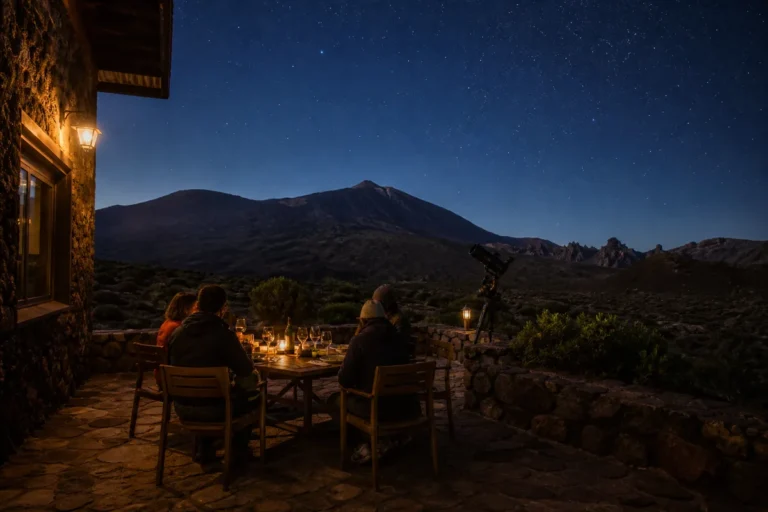
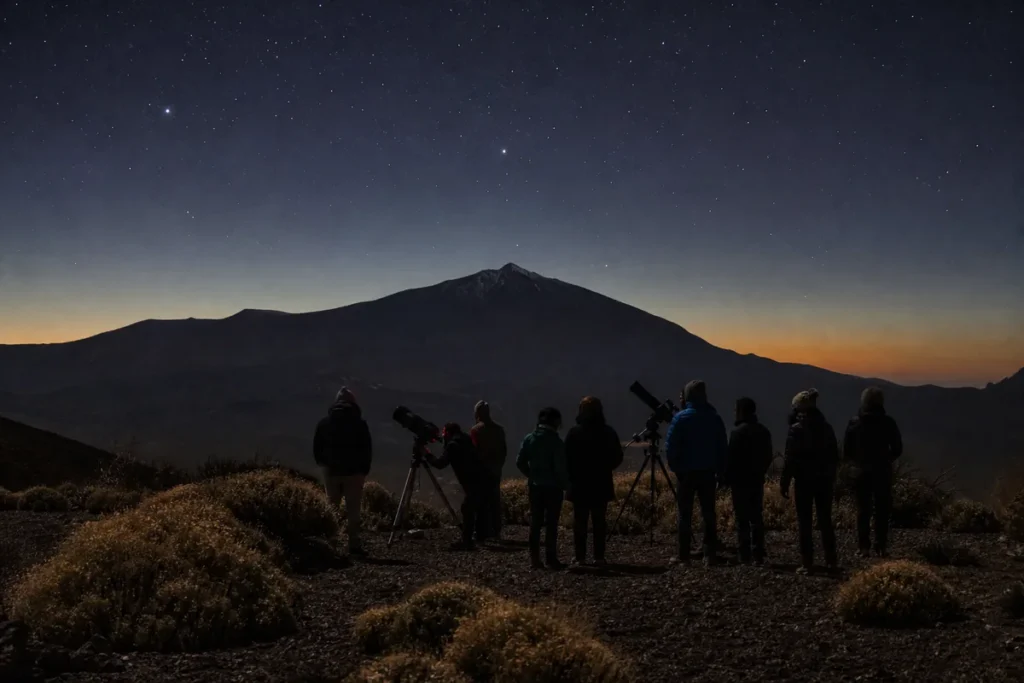
A Teide sunset and stargazing excursion combines, on a single trip with transport, the sunset from a viewpoint in Teide National Park (Parque Nacional del Teide) and a guided astronomy session once it gets dark. Telescopes are normally used, and a specialist guide explains constellations, planets and deep-sky objects.
It is the most common way to see the Teide sky without driving at night. Here we explain how the time is split, what changes between offers and what happens if it is cloudy.
At a glance
| Aspect | What to expect |
|---|---|
| What it is | Transport + sunset at a viewpoint + guided stargazing |
| Total duration | About 6.5 hours in one of the offers reviewed. Depends on the provider and the pick-up area |
| Observation time | A smaller share of the total; some travellers mention an hour and a half |
| Observation altitude | Around 2,200–2,400 metres in the offers reviewed |
| Equipment | Telescopes and a laser pointer in most offers. Depends on the provider |
| Dinner | Optional or not included; if dinner is the focus, see Teide dinner and stargazing |
| Minimum age | Depends on the provider; one of the offers reviewed does not accept children under 8 |
| If it is cloudy | Some providers refund the price if observation is not possible. Check this |
What happens
The trip starts in the mid-afternoon. The pick-up time changes throughout the year because it is calculated from the time of sunset.
- Drive up to the park, a little over an hour from the coast depending on the pick-up area.
- Sunset from a viewpoint in the national park. The exact spot varies with the time of year and visibility.
- Break for a bite to eat, with a picnic included or on your own.
- Stargazing once it is dark: a naked-eye tour of the sky with a laser pointer and turns at the telescopes.
- Return to the pick-up area.
What you can see
It depends on the time of year, the Moon and the weather. With a good sky, the usual programme is a tour of the constellations with the naked eye and, through the telescope, the Moon, a planet visible that night, star clusters or bright nebulae. No serious provider guarantees specific objects.
Why the Teide sky is special
The quality of the Canary Islands sky is protected by what is known as the Sky Law (Ley del Cielo, Law 31/1988), the world’s first national sky protection law according to the Instituto de Astrofísica de Canarias. It regulates light pollution, radio interference, atmospheric pollution and flight paths over the observatories.
In Tenerife, the outdoor lighting rules only apply to the part of the island with a direct line of sight from La Palma. That is why, in the national park, altitude is the main factor: you are above the sea of clouds and far from the lights of the coast.
Formats and differences
| Format | What sets it apart | Suits you if… |
|---|---|---|
| Standard group | Coach and several shared telescopes | You want a reasonable price per person |
| Small group | Minibus for up to about 8 people | You want more time at the telescope and fewer pick-up stops |
| With cable car at sunset | Sunset at 3,555 m, then observation at the base | You want the highest sunset; there are health and age restrictions |
| With dinner | Dinner is part of the product | See Teide dinner and stargazing |
| Private | Your group only, flexible timing | See the private stargazing tour |
| With a walk | A sunset hike is the focus | See Teide sunset and stargazing hike |
Where it takes place
The sunset is watched from a viewpoint in Las Cañadas del Teide. In the cable car operator’s offer reviewed, observation takes place in a lay-by next to its base station, at about 2,356 metres. Another offer reviewed observes at about 2,200 metres.
Pick-ups are concentrated in the south and the north of the island. Not every area has a departure every day.
Who it suits
- Travellers who want to see the Teide sky without driving mountain roads at night.
- Couples, friends and families with children who meet the provider’s minimum age.
- People with no knowledge of astronomy: the explanation starts from scratch.
Who it may not suit, and what to weigh up
- Anyone who wants to spend most of the time stargazing: a good part of the excursion is transport and waiting for darkness. A small group or a private format makes better use of the night.
- Young children: some offers have a minimum age and you get back late.
- Anyone who does not cope well with cold or cannot stand for a long time.
- If you take the cable car at sunset: pregnant women, children under 3 and people with cardiovascular problems or reduced physical or motor mobility cannot ride.
How to choose well
- How long does the actual observation last? Not just the whole excursion.
- How many people per telescope? And how many telescopes are there?
- Who leads the observation? Some operators work with guides accredited by the Starlight Foundation.
- What happens if there is cloud or calima (dust haze)? Is the price refunded, is the date changed or does it go ahead anyway?
- Where is the sunset viewed and how far do you have to walk to get there?
- Is there a picnic or dinner? A vegetarian option?
- Minimum age and documents for child rates?
- What is the cancellation policy? In the offer reviewed, free up to 24 hours before.
What is usually included and what to check
| Item | Usual practice | Check |
|---|---|---|
| Transport | Included from a meeting point | Distance from your hotel and time |
| Astronomy guide | Included | Language and accreditation |
| Telescopes | Included | Number and type |
| Picnic or dinner | Optional | Menu and allergies |
| Warm clothing | Rarely included | Bring your own |
| Cable car | Only in some versions | Plan B if it closes |
Safety and health
- Cold: at night, above 2,000 metres, the temperature can drop sharply, even in summer.
- Altitudee: if you have heart or breathing problems, consult your doctor.
- Darkness: use only the light the guide recommends. White torches and camera flashes spoil the whole group’s night vision.
Weather, the Moon and time of year
- Cloud and calima: they can prevent observation. In the offer reviewed, if the weather prevents observation, the price of the activity is refunded.
- Moon: with a full or nearly full Moon, fewer faint stars and nebulae are visible, although the Moon itself is a spectacular telescope target. If deep-sky objects interest you, choose dates close to the new Moon.
- Seasons: winter brings long nights and more cold; in summer, the Milky Way is more visible in the early part of the night.
Price: what it depends on
We do not give a reference figure: the offers reviewed differ in transport, group size, cable car and food, and there are not enough directly comparable prices.
The price per person depends on:
- Group size: standard or small.
- Whether a sunset cable car ride is included.
- Whether a picnic or dinner is included.
- The pick-up area.
What to bring
- Properly warm clothing: a down or fleece jacket, hat and gloves.
- Closed shoes.
- A torch with a red light, if you have one.
- Water and a snack if there is no picnic.
- Proof of age if there is a child rate or minimum age.
Alternatives and how to compare them
| If you are looking for… | Best option |
|---|---|
| Stargazing only, without sunset | Stargazing in Tenerife |
| Dinner as the main feature | Teide dinner and stargazing |
| Your group only and flexible timing | Private stargazing tour in Tenerife |
| Walking before the observation | Teide sunset and stargazing hike |
| Photographing the sky | Teide astrophotography tour |
Frequently asked questions
Worth knowing before you choose
How long does the sunset and stargazing excursion last?
Around 6.5 hours in one of the offers reviewed, including transport. The observation itself takes up a smaller part.
Can you always see the stars?
No. Cloud, calima or wind can prevent it. Ask what the provider does in that case.
What can you see through the telescope?
It depends on the night: the Moon, visible planets, clusters or bright nebulae. Specific objects cannot be guaranteed.
Is it very cold?
Yes, it can be, even in summer. Bring a warm jacket, hat and gloves.
Can children come?
It depends on the provider’s minimum age; one offer reviewed sets it at 8.
Is dinner included?
It is usually optional or not included. If you want dinner as the centrepiece, see the dinner and stargazing page.
When is the best time to go?
Close to the new Moon to see more faint stars. With a full Moon, deep-sky viewing is poorer, but the Moon through a telescope is spectacular.
Do you go up by cable car?
Only in some versions, which go up to 3,555 metres for the sunset and come back down for the observation.
Experience details
The essentials, before you choose
- Duration
- Around 6.5 hours, depending on provider and pick-up area
- Group
- Shared group; size depends on the provider
- Pick-up
- Pick-up point according to area and provider
- Languages
- Depends on the departure
It may suit you
An option for
- Couples
- Families
- Small groups who want to combine scenery and astronomy
Worth checking
Not a good fit if
- Anyone looking for a photography service
- Groups of more than 8 people without a tailored logistics plan
- Anyone who needs a fixed time before giving their date and accommodation
Frequently asked questions
Worth knowing before you choose
How long does the sunset and stargazing excursion last?
Around 6.5 hours in one of the offers reviewed, including transport. The observation itself takes up a smaller part.
Can you always see the stars?
No. Cloud, calima or wind can prevent it. Ask what the provider does in that case.
What can you see through the telescope?
It depends on the night: the Moon, visible planets, clusters or bright nebulae. Specific objects cannot be guaranteed.
Is it very cold?
Yes, it can be, even in summer. Bring a warm jacket, hat and gloves.
Can children come?
It depends on the provider's minimum age; one offer reviewed sets it at 8.
Is dinner included?
It is usually optional or not included. If you want dinner as the centrepiece, see the dinner and stargazing page.
When is the best time to go?
Close to the new Moon to see more faint stars. With a full Moon, deep-sky viewing is poorer, but the Moon through a telescope is spectacular.
Do you go up by cable car?
Only in some versions, which go up to 3,555 metres for the sunset and come back down for the observation.