Before you choose
What you need to know about this experience
A guided ascent of Pico del Teide is a climb to the summit of the volcano, at 3,715 metres, accompanied by a guide and with the permit for the crater access trail already arranged. This format coordinates professional guiding, permits and logistics to reach the top; the cable car and sightseeing excursions do not, on their own, go as far as the crater.
Access to the final section is regulated and has a daily quota. This page explains which permits you need depending on the route, the fitness level each option requires and the conditions providers usually apply.
At a glance
| Aspect | What to expect |
|---|---|
| What it is | Guided ascent to the summit of Teide (3,715 m) |
| Essential permit | PNT 10 Telesforo Bravo trail, booked on Tenerife ON |
| Ways up | Cable car + final section on foot; full ascent on foot from Montaña Blanca; night in the refuge and sunrise climb |
| Difficulty | High because of the altitude, even though the final section is short |
| Duration of the walk from the cable car | About 2 hours there and back, according to one operator |
| Minimum age | Depends on the provider; one of those reviewed does not accept children under 6 |
| Cancellations | Very restrictive: permits generally cannot be changed or refunded |
| Price | Per person. Depends on the provider and whether the cable car and transport are included |
Which permit you need
There is no single Teide permit. There are two regulated trails, and each route uses one or both.
| Trail | Section | When you need it |
|---|---|---|
| PNT 10 Telesforo Bravo | From La Rambleta (3,555 m) to the crater | Always if you want to reach the summit |
| PNT 07 Montaña Blanca – La Rambleta | From the Montaña Blanca car park to La Rambleta | If you climb on foot from below |
Both are booked on the official platform Tenerife ON, run by the Cabildo de Tenerife. According to the official announcement of January 2026, a new week of places opens every Monday at 07:00 (Canary Islands time), with a 28-day window. You need to register and provide the details of everyone in the group.
Since 19 January 2026, both trails have had a public fee in certain time slots. For the PNT 10, between 09:00 and 17:00:
| Profile | PNT 10 fee |
|---|---|
| Tenerife residents | Free |
| Under-14s | Free |
| Residents of the other Canary Islands | €6 |
| Everyone else | €15 |
The PNT 07 has different fees on working days and public holidays. On some guided ascents, the provider applies for the permit in each participant’s name and includes its cost; on others, confirmation depends on getting a place. Check this in writing.
The three ways to climb with a guide
1. Cable car + final section on foot
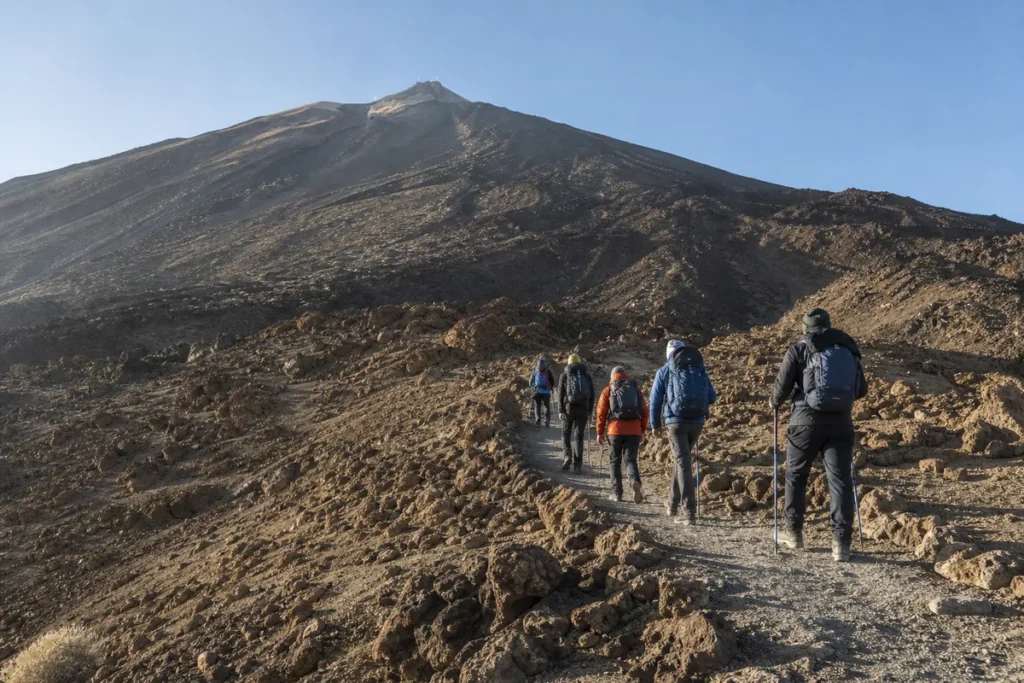
This is the most common option. You take the cable car up to La Rambleta and from there walk with the guide along the Telesforo Bravo trail to the crater.
- The section is short in distance, but steep and above 3,500 metres.
- One operator states about 2 hours of walking up and down, with a high level of difficulty.
- Requires one permit: the PNT 10.
2. Full ascent on foot from Montaña Blanca
You start at about 2,350 metres and climb the whole height gain on foot.
- According to the cable car operator, it is about 9 kilometres and between 6 and 7 hours to the summit.
- Requires two permits: PNT 07 and PNT 10.
- For the descent, you need to decide in advance whether you will walk or take the cable car, and check that the timetable works.
3. Night at the Refugio de Altavista and sunrise at the summit
The Refugio de Altavista reopened in July 2026 after a full refurbishment. A refuge booking includes the official permits to access via the PNT 07 and walk the PNT 10 between 06:00 and 09:00 on the morning after the overnight stay, according to the operator’s current information.
- The refuge is at 3,260 metres and can only be reached on foot.
- An overnight stay requires a sleeping bag and suitable high-mountain equipment.
- Capacity, opening times, services and availability may change; check them before organising the ascent.
It is the most demanding option in terms of logistics and effort, but it lets you split the climb and tackle the final section at sunrise.
What happens on an ascent with the cable car
- Pick-up early. In one of the offers reviewed, between 07:00 and 09:30.
- Arrival at the base station (2,356 m) and footwear check.
- Cable car ride up to La Rambleta (3,555 m), about 8 minutes.
- PNT 10 access check. You must show an ID card or passport.
- Climb to the crater with the guide, at a slow pace.
- Time at the summit and descent by the same trail.
- Cable car down. On busy days, some travellers report waits of more than half an hour to get down.
- Return to the pick-up point.
Who it suits
- Healthy, physically fit people who want to reach the summit.
- Anyone who has not managed to get a permit themselves or does not want to coordinate permit, ticket and timings.
- Experienced hikers who prefer to be accompanied above 3,500 metres.
Who it may not suit, and what to weigh up
- Pregnant women, people with cardiovascular problems and children under 3: they cannot ride the cable car. One operator reviewed also does not accept children under 6 on the ascent to the peak.
- People with reduced mobility or injuries: not recommended, and the cable car does not accept people with reduced physical or motor mobility.
- Anyone who does not cope well with altitude: above 3,500 metres there is less oxygen; you will notice the shortness of breath even if you are fit.
- Anyone who needs flexible dates: once the permit is confirmed, changes and refunds are usually not possible.
If you have any health problems, consult your doctor before booking.
How to choose the right provider
- Exactly which permit is included? PNT 10, PNT 07 or both.
- Has the permit already been issued, or does the booking depend on getting it? Some operators do not confirm until they have the permit in your name.
- Is the cable car ticket included? Not always: at least one of the offers reviewed excludes it.
- Who is guiding, and with what accreditation? Ask what professional qualification the guide holds for the mountain route, what accreditations the national park requires and whether the operator appears in the relevant registers.
- What happens if the cable car or the trail closes? Is there another route? Which part is refunded?
- What happens if there is snow or ice? Are crampons and an ice axe needed? Who provides them?
- What are the minimum age and maximum group size?
- What cancellation policy applies?
What is usually included and what to check
| Item | Usual practice | Check |
|---|---|---|
| PNT 10 permit | Included and arranged in your name | That it is confirmed before you pay in full |
| PNT 07 permit | Only if you climb on foot from Montaña Blanca | That it is stated in writing |
| Cable car ticket | Included in some offers | Whether it is a return ticket |
| Guide | Included | Language and accreditation |
| Transport | Included in some offers | Pick-up area and time |
| Technical equipment | Not included | If there is snow, who provides crampons and an ice axe |
| Food and water | Not included | Bring your own |
Safety, requirements and equipment
- ID document: required at the entrance to the crater trail.
- Closed mountain footwear: one operator states that without it you will be refused entry to the trail.
- Compulsory equipment for the PNT 07 (according to the official Tenerife ON sign): warm jacket, closed mountain footwear, water, emergency foil blanket, long trousers, charged mobile phone, head torch or torch, and gloves and hat in winter.
- Snow or ice: the trail may close. When there is snow, some operators only allow access with technical clothing, crampons and an ice axe.
- Guide’s decision: if the guide considers your physical condition unsuitable, they may ask you not to continue.
- Cable car failure: anyone at the top would have to walk down on mountain trails.
Altitudee is the main risk. Climb slowly, drink water and tell the guide about any dizziness, severe headache or difficulty breathing.
Weather and closures
- Wind can close the cable car. In that case, one offer reviewed switches to an alternative walk in the park and refunds the price difference.
- The trail may close even if the cable car is running. The same offer replaces the ascent to the peak with a visit to La Rambleta and another walk, and refunds part of the price.
- In winter, snow and ice are common at the summit.
Check Tenerife ON for trail closure notices, and the cable car status the day before.
Price: what it depends on
We do not give a reference figure: the offers reviewed are not comparable because some include the cable car and transport and others do not.
The price of a guided ascent depends on:
- Which permits are included (PNT 10 only, or PNT 10 + PNT 07).
- Whether the cable car ticket is included, which is one of the most expensive components.
- Whether transport is included from your accommodation.
- Format: small group or private guide.
- Route: cable car, full ascent or night in the refuge.
The public trail fees are in the table at the top. Always ask whether the price already includes them.
What to bring
- Closed hiking boots or trail shoes with good soles.
- Warm layers, a hat and gloves.
- Sunglasses and high-factor sun protection.
- At least a litre of water and something to eat.
- ID card or passport.
- A charged phone and, if you are climbing on foot or before dawn, a head torch.
- Crampons and an ice axe if there is snow and the provider requires them.
Alternatives and how to compare them
| If you are looking for… | Best option |
|---|---|
| Taking the cable car without going to the crater | Teide excursion with cable car |
| Walking in the park with less effort | Teide sunset and stargazing hike |
| Seeing the park without walking | Group Teide excursion |
| Arranging everything for your group only | Private Teide tour |
| Another guided mountain route | Guided hiking in Anaga |
Frequently asked questions
Worth knowing before you choose
Can you climb Pico del Teide without a permit?
No. The final section, the PNT 10 trail, requires a booking on Tenerife ON. The time of your climb should not be taken as an exception.
Does the cable car ticket include the climb to the crater?
No. The cable car goes to La Rambleta. To continue to the summit you need the PNT 10 permit.
How long does it take from the cable car to the summit?
One operator states about 2 hours up and down. It depends on the group’s pace and how the altitude affects you.
Is it very hard?
The section is short, but the altitude makes it demanding. You need good physical fitness and no heart or breathing problems.
How much does the permit cost?
Since January 2026, the PNT 10 costs €15 for non-residents of the Canary Islands between 09:00 and 17:00, and €6 for residents of the other islands. It is free for Tenerife residents and under-14s.
Can I cancel if the weather changes?
It depends on the provider. Official permits are not refunded except for closure due to weather, exceptional circumstances or the cable car not operating. Many operators do not accept changes once the booking is confirmed.
Can children go up?
Only from the minimum age set by the provider. One of those reviewed does not accept children under 6, and children under 3 cannot use the cable car.
Can you see the sunrise from the summit?
Yes, with the option linked to an overnight stay at the Refugio de Altavista and its early-morning permits. The refuge reopened in July 2026; confirm availability, equipment and timings before planning it.
Experience details
The essentials, before you choose
- Duration
- Varies depending on cable car or full ascent
- Group
- Small group, depending on provider and permit
- Pick-up
- Included only in some formats
- Languages
- Depends on the guide assigned
- Guide
- Professional qualified for the format booked
- Equipment
- Mountain equipment required; requirements depend on trail and weather
It may suit you
An option for
- Hikers
- Active travellers
- Small groups
Frequently asked questions
Worth knowing before you choose
Can you climb Pico del Teide without a permit?
No. The final section, the PNT 10 trail, requires a booking on Tenerife ON. The time of your climb should not be taken as an exception.
Does the cable car ticket include the climb to the crater?
No. The cable car goes to La Rambleta. To continue to the summit you need the PNT 10 permit.
How long does it take from the cable car to the summit?
One operator states about 2 hours up and down. It depends on the group's pace and how the altitude affects you.
Is it very hard?
The section is short, but the altitude makes it demanding. You need good physical fitness and no heart or breathing problems.
How much does the permit cost?
Since January 2026, the PNT 10 costs €15 for non-residents of the Canary Islands between 09:00 and 17:00, and €6 for residents of the other islands. It is free for Tenerife residents and under-14s.
Can I cancel if the weather changes?
It depends on the provider. Official permits are not refunded except for closure due to weather, exceptional circumstances or the cable car not operating. Many operators do not accept changes once the booking is confirmed.
Can children go up?
Only from the minimum age set by the provider. One of those reviewed does not accept children under 6, and children under 3 cannot use the cable car.
Can you see the sunrise from the summit?
Yes, with the option linked to an overnight stay at the Refugio de Altavista and its early-morning permits. The refuge reopened in July 2026; confirm availability, equipment and timings before planning it.