Before you choose
What you need to know about this experience
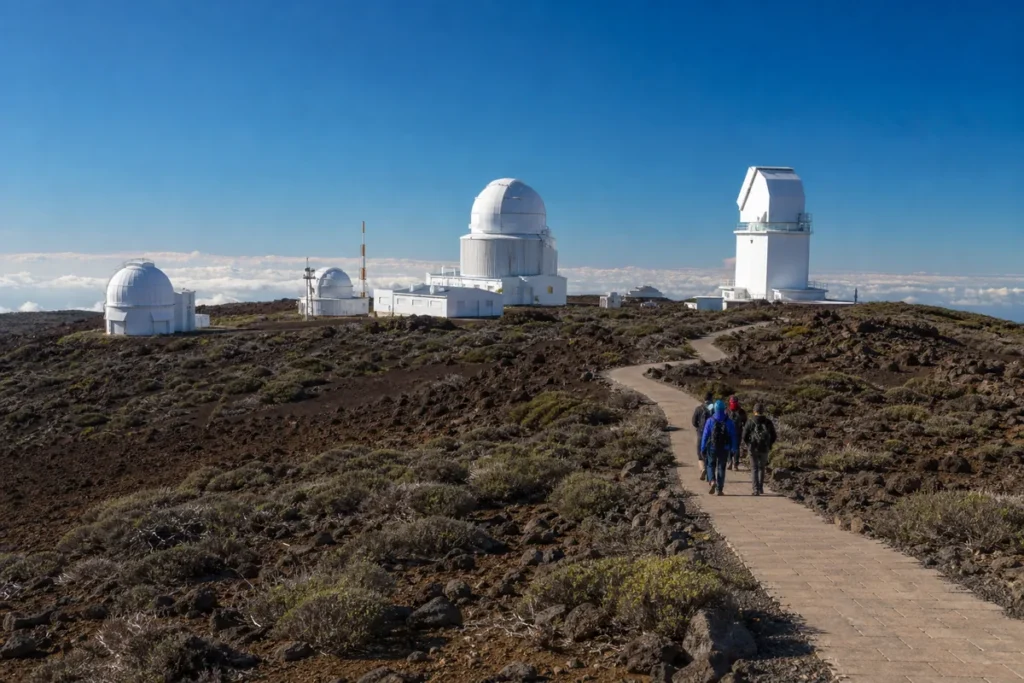
The Teide Observatory visit is a guided tour by day of the Instituto de Astrofísica de Canarias (IAC) research facilities at Izaña, at about 2,390 metres above sea level. It includes an explanation of the Canary Islands sky, observation of the Sun with portable telescopes and a look inside a night-time telescope.
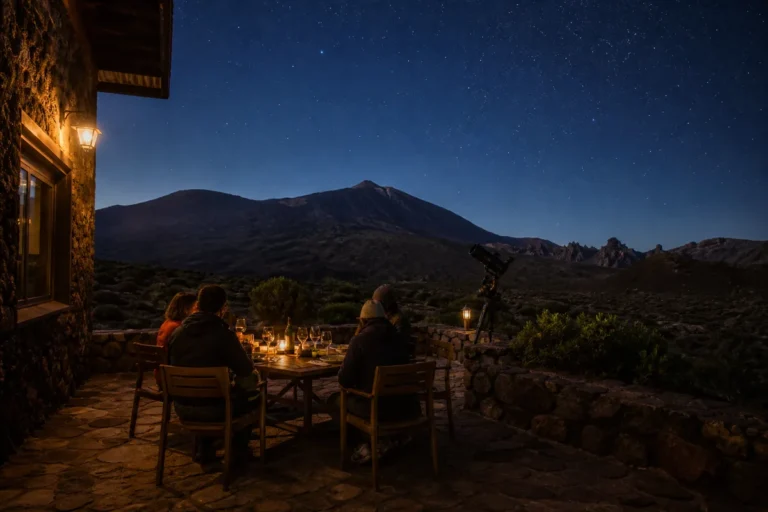
It is not a stargazing session: the observatory cannot be visited at night. If what you are after is the night sky, see stargazing in Tenerife.
At a glance
| Aspect | What to expect |
|---|---|
| What it is | Guided daytime visit to an astronomical research centre |
| Where | Izaña, next to the TF-24 road, at about 2,390 m above sea level |
| Duration | About 1 hour 30 minutes, according to the channel that sells the visits |
| What you see | Astrophysics workshop, solar observation and the inside of a night-time telescope |
| Minimum age | 8 years |
| Languages | Spanish, English, German and French, depending on the day |
| Public transport | Not an option: you need your own vehicle or booked transport |
| Price | €21 per adult in September 2026; free for ages 8 to 16 (see the price section) |
What the Teide Observatory is
The Teide Observatory began operating in 1964 and is run by the Instituto de Astrofísica de Canarias. It specialises in solar observation and houses solar and night-time telescopes from several European countries.
Its location above the sea of clouds and the legal protection of the Canary Islands sky make it one of the world’s leading astronomical sites, according to the IAC itself.
What happens on the visit
- Meeting at the access barrier, 30 minutes before your allotted time.
- Drive in your own vehicle about 2 kilometres to the starting point, following the guide.
- Introduction and astrophysics workshop at the visitor centre.
- Solar observation with portable solar telescopes fitted with special filters, to see sunspots and prominences if solar activity and the sky allow.
- Visit inside a night-time telescope, usually the Carlos Sánchez or the IAC-80.
The solar telescopes cannot be visited inside, so as not to interrupt the researchers’ work. Some travellers note in their reviews that the visit is somewhat limited in what you can see inside; it is worth going with that expectation.
Available formats
| Format | What sets it apart | Suits you if… |
|---|---|---|
| Guided visit, arriving on your own | Just the visit; you arrive by car | You have a vehicle and want the simplest format |
| Excursion with transport and visit | Includes transport and other stops in the park | You do not have a car |
| Observatory + night-time stargazing | Daytime visit and stargazing at night at another spot | You want day and night on a single trip |
| IAC open days | Free, on specific dates, in Spanish, with prior registration | Your dates coincide and you are interested in the outreach format |
How to get there
The entrance is at kilometre 1 of the TF-514 road, which leaves the TF-24 at kilometre 37. According to the channel that sells the visits, the journey takes about 2 hours from the south, an hour and a half from Santa Cruz and an hour from Puerto de la Cruz.
- It cannot be reached by public transport, because from the barrier there are almost 2 kilometres to the starting point, which are covered by vehicle.
- If you go by taxi, the taxi must wait outside the facilities.
- Access by bicycle is not allowed.
If you do not have a car, the practical option is an excursion with transport included or a private Teide tour that includes the visit.
Who it suits
- People interested in science, astronomy or technology.
- Families with children aged 8 and over.
- Anyone who already knows the national park and wants another way to see the high mountains.
Who it may not suit, and what to weigh up
- Children under 8: not admitted.
- People with heart or breathing problems, anaemia or reduced mobility: not recommended, because of the altitude and because you walk on gravel paths and stairs.
- Anyone who wants to see the stars: the visit takes place by day.
- Anyone who does not understand the language of the visit well: the sales channel asks for sufficient knowledge of the language to follow the explanations.
How to choose well
- Is it just the tour, or is transport included?
- In which language and on which days? Not everand thenguage has a visit every day.
- What happens if the weather is bad? Visits can be cancelled because of snow, ice or rockfalls, especially in winter.
- Is separate night-time stargazing included? If so, where and with what equipment?
- What is the change policy? In the channel reviewed, free up to 24 hours before.
What to bring and the rules to follow
- ID card or passport and your booking confirmation. Without them, access is not guaranteed.
- Warm clothing, even if it is sunny: the buildings are cool and the weather changes quickly.
- A cap, sunglasses and sun protection.
- Water: the air is very dry.
- Closed shoes; no sandals or heels.
During the visit you may not eat or smoke, leave the paths or touch anything inside the buildings. There are toilets only at the start of the tour.
Safety and health
At 2,390 metres there is less oxygen. The observatory has no medical assistance and the nearest hospital is more than an hour away by car. If you feel dizzy or have a headache, nausea or shortness of breath, tell the guide straight away.
Weather
- Winter: snow, ice or rockfalls can cancel the visit at short notice. In the channel reviewed, the price is refunded if access is not possible for technical or weather reasons.
- Clouds: they can prevent solar observation; the itinerary is adapted.
- Sun: the radiation is intense all year round.
Price
In September 2026, the guided daytime visit was sold at €21 per adult through the channel that sells visits to the observatory, without transport. Children aged 8 to 16 go free on showing proof of age.
This price is for the visit only. If you need transport or combine it with other activities, the price goes up depending on the provider. The IAC open days are free, but they only take place on specific dates and places are limited.
Alternatives and how to compare them
| If you are looking for… | Best option |
|---|---|
| Seeing the stars at night through a telescope | Stargazing in Tenerife |
| Sunset and stars on one trip | Teide sunset and stargazing |
| Seeing the national park with transport | Group Teide excursion |
| Planning a private day that includes the visit | Private Teide tour |
Frequently asked questions
Can you visit the Teide Observatory at night?
No. Visits take place by day. Night-time stargazing is done at other spots in the park with portable telescopes.
How long does the visit last?
About 1 hour 30 minutes, plus arrival time: you must be at the barrier 30 minutes beforehand.
Can you get there by bus?
No. From the barrier there are almost 2 kilometres covered by vehicle. You need a car or booked transport.
Can children come?
From age 8. From 8 to 16, entry is free in the channel reviewed.
What do you see?
An astrophysics workshop, the Sun through telescopes with special filters and the inside of a night-time telescope.
Can you go inside the solar telescopes?
No, so as not to interrupt the scientific work. You visit the inside of a night-time telescope.
What happens if the weather is bad?
The visit can be cancelled because of snow, ice or rockfalls. In the channel reviewed, the price is refunded.
Are there free open days?
The IAC organises open days on specific dates, in Spanish and with prior registration until places run out.