
Before you choose
What you need to know about this experience
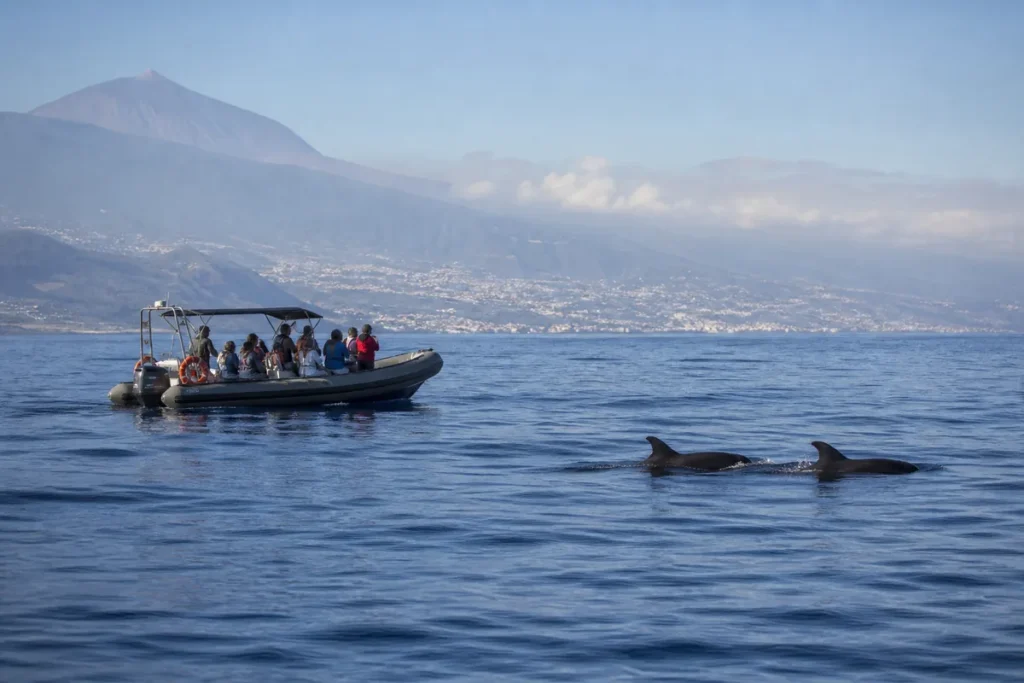
Whale and dolphin watching in Tenerife is a boat trip, usually from the south-west coast, to observe cetaceans in their natural habitat with an authorised operator. The species seen most often are the short-finned pilot whale and the bottlenose dolphin, which live permanently in the strip of sea between Tenerife and La Gomera.
It is a regulated activity: the boat needs specific authorisations and must follow distance and time rules. This page helps you check them and choose the type of trip that suits you.
At a glance
| Aspect | What to expect |
|---|---|
| What it is | Boat trip to observe cetaceans with an authorised operator |
| Area | Teno-Rasca marine strip, between the south of Tenerife and La Gomera |
| Common species | Short-finned pilot whale and bottlenose dolphin; other species occasionally |
| Duration | Usually 2 or 3 hours. Depends on the provider |
| Usual ports | Puerto Colón, Los Cristianos, Los Gigantes and others on the south-west coast |
| Boats | Tastingmaran, sailing boat, motorboat or speedboat |
| Authorisations | Barco Azul badge and AROC authorisation from the Ministry |
| Wildlife guarantee | No serious operator can guarantee it |
| Price | Depends on the provider, the duration and the type of boat |
Why Tenerife
The Teno-Rasca marine strip, about 22 kilometres of sea between Punta de Teno and Punta Rasca, is protected as a Special Area of Conservation. In 2021 the World Cetacean Alliance recognised it as Europe’s first Whale Heritage Site, according to Canarias Destino. The distinction does not reward the number of animals, but the fact that whale watching is done responsibly.
Because there are resident groups, the chances of a sighting are high all year round, although there is no guarantee.
Which authorisations the boat must have
| Authorisation | Issued by | What to check |
|---|---|---|
| Barco Azul / Blue Boat badge | Canary Islands Government | A yellow 80 × 50 cm flag with two white pilot whales and the authorisation period in blue figures, visible on the boat |
| AROC authorisation (Actividad Recreativa de Observación de Cetáceos, i.e. recreational whale watching) | Spanish Ministry for the Ecological Transition (MITECO) | That the boat’s name appears on the official list for the Teno-Rasca Marine Strip SAC (ZEC) |
Under the Canary Islands’ Decreto 178/2000, whale-watching companies must also carry a sector-specific tourist guide on board. MITECO announced a moratorium on new AROC authorisations in the Teno-Rasca strip, which limits the number of authorised boats.
Practical tip: if a boat appears on the Ministry’s list with an authorisation for Tenerife excepto ZEC Franja Teno-Rasca (Tenerife except the Teno-Rasca SAC), it cannot carry out whale watching in the main area in the south. Ask the provider for the boat’s name and check it.
Watching rules
Turismo de Tenerife summarises the rules boats must follow as follows:
- Do not approach closer than 60 metres to the animals.
- 30 minutes as the maximum watching time.
- Sail at reduced speed.
- Avoid boats gathering together.
- Leave the area if the animals are disturbed.
Swimming with the animals, feeding them, throwing waste and disturbing them with noise are all prohibited. That is why you will see them further away than in many promotional photos: that is what the law requires.
Available formats
| Format | What sets it apart | Suits you if… |
|---|---|---|
| Short trip (about 2 h) | Main aim: cetaceans | You are short of time or travelling with children |
| Long trip (about 3 h or more) | Includes a swimming stop and a meal on many offers | You want to spend more time at sea |
| By catamaran | Stable and spacious | You are worried about seasickness; see also the catamaran excursion |
| By sailing boat | Calmer sailing | You like sailing; see the sailing excursion |
| By speedboat | Small group and closer to the water | You want something more dynamic; see the sea safari |
| With a specialist | Small group and a biologist on board | You are interested in the scientific explanation; see the expedition with a biologist |
| Private | A boat just for your group | See the private boat |
Where tours start
Most trips leave from the south-west coast, close to the Teno-Rasca strip: Puerto Colón (Costa Adeje), Los Cristianos and Los Gigantes. From Los Gigantes you also sail alongside its cliffs.
Who it suits
- Families with children, on short trips and stable boats.
- Nature lovers who want to see cetaceans in the wild.
- Couples and groups who combine whale watching, swimming and a meal.
Who it may not suit, and what to weigh up
- People who get seasick easily: choose a large, stable boat and a short trip.
- Anyone expecting to see big whales for sure: the most common are pilot whales and dolphins; other species are occasional.
- Anyone who wants to swim with dolphins: it is prohibited.
- Pregnant women or people with back problems: avoid speedboats.
How to choose well
- What is the boat’s name? Check it on the Ministry’s AROC list.
- Does it fly a valid Barco Azul flag?
- Actual duration, and sailing time to the area?
- Type of boat and maximum number of passengers?
- Does it include swimming, food or drinks?
- Is there a guide or biologist on board to explain?
- What happens if the sea is rough? Change of date or refund?
- Pick-up from your hotel, or do you get to the port yourself?
What is usually included and what to check
| Item | Usual practice | Check |
|---|---|---|
| Boat trip | Included | Type and capacity |
| Guide on board | Compulsory under Decreto 178/2000 | Language |
| Drinks or food | On long trips | What it includes |
| Snorkellingling gear | On some trips with a swim | If it interests you |
| Transport to the port | In some offers | Area and time |
Safety and requirements
- Motion sickness: if you are prone to it, take precautions before boarding and stay in the middle of the boat.
- Sun: radiation at sea is intense. Wear a cap, sunglasses and sun protection.
- Children: check that there are life jackets in their size.
- Reduced mobility: ask about access to the boat, which may involve steps or a gangway.
Weather and time of year
- Pilot whales and dolphins are present all year round.
- Wind and sea from the south and west can cancel trips or make them rougher.
- In the morning the sea is usually calmer than in the afternoon in many areas of the south, although it depends on the day.
Price: what it depends on
We do not give a reference figure: offers combine duration, type of boat, food and transport in very different ways.
The price depends on:
- The duration.
- The type of boat and the group size.
- Food, drink and swimming included or not.
- Transport from your accommodation.
What to bring
- Sun protection, a cap and sunglasses.
- A jacket or windbreaker: it gets cooler at sea.
- Swimwear and a towel if the trip includes a swim.
- Motion sickness remedy, if you need one.
- A camera with a zoom lens, because the animals are seen from a distance.
Alternatives and how to compare them
| If you are looking for… | Best option |
|---|---|
| Scientific explanation and a small group | Marine wildlife expedition with a biologist |
| A boat just for your group | Private boat in Tenerife |
| Tastingmaran with a meal and a swim | Tastingmaran excursion |
| Something faster and more dynamic | Speedboat sea safari |
| Seeing the seabed without getting wet | Glass-bottom boat |
Frequently asked questions
Can you see whales in Tenerife?
The most common are short-finned pilot whales and bottlenose dolphins. Other species of whales and dolphins are seen occasionally.
Am I sure to see cetaceans?
No. The chances are high because there are resident groups, but no serious operator can guarantee it.
How do I know whether the boat is authorised?
It must fly the Barco Azul flag and appear on the Ministry’s list of AROC authorisations for the Teno-Rasca SAC.
Can I swim with dolphins?
No. Swimming with cetaceans is prohibited.
How long does the trip last?
Usually 2 or 3 hours, depending on the offer.
What is the best time of year?
Pilot whales and dolphins are there all year round. Sea conditions matter more than the season.
Will I get carsick?
It depends on you and on the sea. Choose a stable boat and a short trip if you are prone to it.
Why don’t they get closer to the animals?
The regulations set a minimum distance of 60 metres and a maximum of 30 minutes of watching.