
Before you choose
What you need to know about this experience
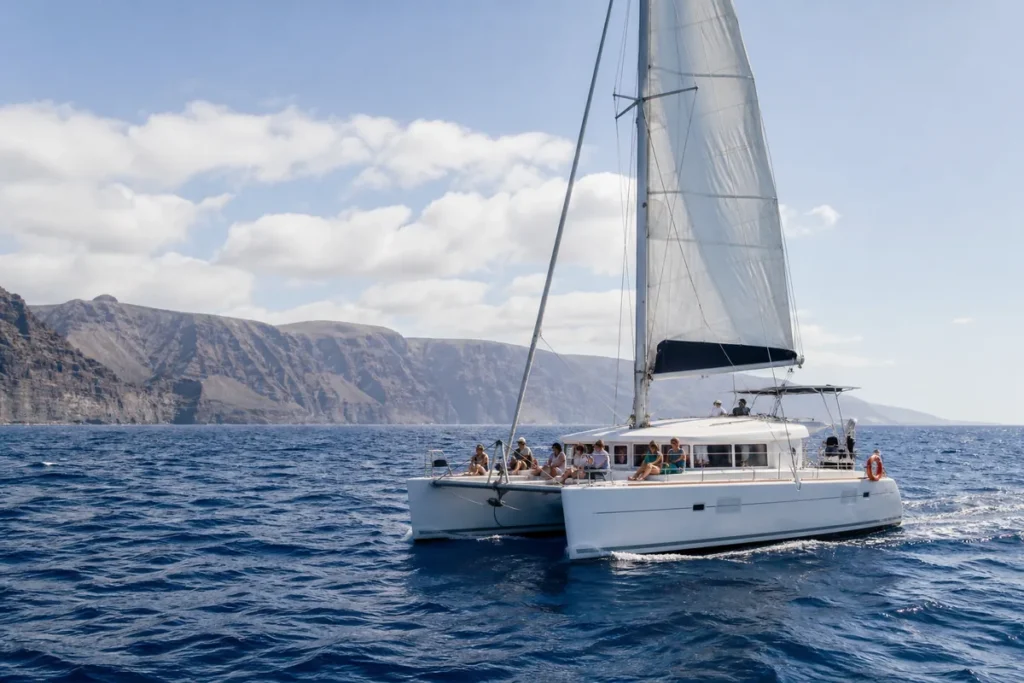
A catamaran excursion in Tenerife is a shared trip of about 2 to 5 hours on a twin-hulled boat, more stable and spacious than a conventional boat, which sails along the south or west coast with stops for swimming and snorkelling. Many include food, drinks and, if the boat is authorised, whale watching.
It is one of the most popular formats with families and people who get seasick. This page helps you tell the types of trip apart and know what to check, including what lies behind the eco label.
At a glance
| Aspect | What to expect |
|---|---|
| What it is | Shared catamaran trip along the coast |
| Duration | About 2–5 hours, depending on the offer |
| Usual ports | Puerto Colón, Los Cristianos, Las Galletas, Los Gigantes |
| Stability | Greater than a single-hulled boat, thanks to its two hulls |
| Includes | Drinks, a meal on long trips, swimming and snorkelling on many offers |
| Cetaceans | Only if the catamaran has Barco Azul and AROC authorisation |
| Group | From small groups to several dozen people |
| Price | Depends on the duration, what is included and the size of the boat |
Types of catamaran trip
| Type | What sets it apart | Suits you if… |
|---|---|---|
| Whale watching | Main aim: whales and dolphins | It is your priority; see the whale and dolphin watching trip |
| Coast, swimming and a meal | Relaxed sailing, anchoring, snorkelling and lunch | You want a full day at sea |
| Sailing catamaran | Sails when there is wind | You like sailing but want more stability than a sailing boat |
| At sunset | Late-afternoon trip | See the sunset boat trip |
| Party boat | Music and a party atmosphere | Groups looking for a party |
| Private catamaran | Your group only | See the private boat |
What lies behind eco catamaran claims
Some operators advertise their catamarans as eco-friendly or sustainable. This can mean different things: solar panels, quieter engines, sailing, waste management or reducing plastics on board.
It is not an official certification in itself. If it matters to you, ask what it actually involves: how is the boat powered? What happens to the waste? Does it have any verifiable certification?
What happens
- Meeting at the port or coach pick-up from your area.
- Sailing along the coast with commentary from the crew.
- Looking for cetaceans, if the boat is authorised.
- Anchoring in a bay for swimming and snorkelling.
- Food and drinks on board on long trips.
- Return to port.
Who it suits
- Families with children, for the stability and space.
- People prone to seasickness.
- Groups who want a day at sea with a meal included.
- Travellers who would rather not deal with a private boat.
Who it may not suit, and what to weigh up
- Anyone looking for privacy: some catamarans carry many passengers; ask about capacity.
- Anyone wanting scientific interpretation: see the expedition with a biologist.
- Anyone looking for thrills or speed: see the speedboat sea safari.
How to choose well
- How many passengers does the catamaran carry on that trip?
- Actual time at sea?
- What is included? Drinks (alcoholic or not), food, snorkelling, towels.
- Is it authorised for whale watching (Barco Azul and AROC in the Teno-Rasca SAC)?
- If it claims to be eco-friendly, what does that involve?
- Is there hotel pick-up?
- What happens if the sea is too rough to go out or the route is shortened?
- Is the atmosphere relaxed or party-style?
What is usually included and what to check
| Item | Usual practice | Check |
|---|---|---|
| Tastingmaran trip | Included | Capacity |
| Drinks | Common | Alcoholic or not |
| Food | On long trips | Menu and dietary needs |
| Snorkellingling | Common | Sizes and life jackets |
| Transport | In some offers | Area and time |
| Whale-watching guide | Compulsory if there is whale watching | Language |
Safety and requirements
- Life jackets for everyone, including children.
- Swimming: only when the crew says so and with the boat stopped.
- Alcohol and swimming: do not mix them.
- Sun: look for the shaded areas.
- Reduced mobility: catamarans are usually more accessible than other boats, but check.
Weather and sea
- A catamaran moves less than other boats, but you still feel a swell.
- In many areas of the south the sea is usually calmer in the morning.
- The crew decides whether the boat can anchor for swimming.
Price: what it depends on
We do not give a reference figure: trips vary widely in duration, capacity and what they include.
The price depends on:
- The duration.
- The food and drinks included.
- Transport from the hotel.
- The type of trip: whale watching, coast or party.
What to bring
- Swimwear, towel and a change of clothes.
- Sun protection, a cap and sunglasses.
- A light jacket.
- Soft-soled shoes.
- Motion sickness remedy, if you need one.
Alternatives and how to compare them
| If you are looking for… | Best option |
|---|---|
| Seeing cetaceans as a priority | Whale and dolphin watching |
| A small group under sail | Sailing excursion |
| A boat just for your group | Private boat in Tenerife |
| Seeing the seabed without swimming | Glass-bottom boat |
Frequently asked questions
Does a catamaran move less than other boats?
Yes, its two hulls make it more stable, although you still feel choppy seas.
Can you see dolphins from the catamaran?
Only if the boat is authorised for whale watching. Check this.
Is food included?
On long trips, often yes. On short ones, usually only drinks.
What does eco catamaran mean?
It depends on the operator: solar panels, sails, waste management and so on. Ask what it involves.
Is it suitable for children?
Yes, it is one of the most comfortable formats for families.
How long does it last?
Between about 2 and 5 hours, depending on the offer.
Will I be picked up at my hotel?
Some offers include transport. Ask about it.