Before you choose
What you need to know about this experience
An ecotourism route in Tenerife is a guided nature outing whose main aim is to interpret the environment: endemic plants and wildlife, volcanic formation, ecosystems and their conservation. The physical effort is usually moderate and the pace slow, with frequent stops to observe and explain.
The difference from a hiking route is not the path but the approach. This page helps you recognise a serious offer and choose the area that suits you.
At a glance
| Aspect | What to expect |
|---|---|
| What it is | Guided nature interpretation outing |
| Effort | Generally low or moderate |
| Duration | From half a day to a full day, depending on the area |
| Usual areas | Teide National Park, Anaga, Teno, the Corona Forestal, the coast |
| Group | Usually small |
| Focus | Plants, wildlife, geology, conservation and cultural landscape |
| Audience | Travellers, families, school groups and associations |
| Price | Depends on the provider, the duration and transport |
Ecotourism compared with hiking
| Aspect | Guided hiking | Ecotourism route |
|---|---|---|
| Aim | Walking a route | Understanding the environment |
| Pace | Steady | Slow, with many stops |
| Distance | Medium or long | Short or medium |
| Content | Navigation and safety | Detailed environmental interpretation |
| Who it suits | People with good fitness | All levels, depending on the route |
If you are more interested in walking, see guided hiking in Anaga or in Teno.
Which areas are usually covered
- Teide National Park: volcanic geology and high-mountain plants, a World Heritage Site.
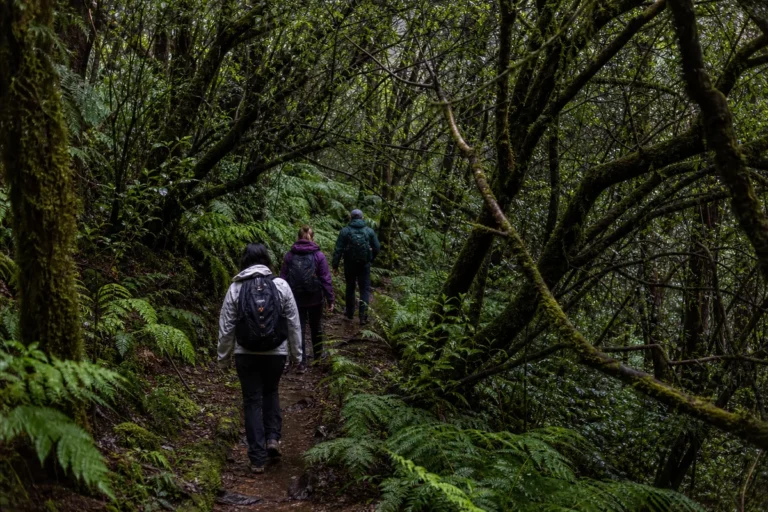
- Anaga Massif: laurel forest, a Biosphere Reserve since 2015.
- Teno Rural Park: cliffs, monteverde and hamlets.
- Corona Forestal: Canary pine forest.
- Coast: lava badlands (malpaíses) and cardón and tabaiba scrub in the south.
Why Tenerife is an ecotourism destination
In February 2026, Turismo de Tenerife announced the renewal of the destination’s Biosphere sustainability certification and the Starlight certification for Teide and the summits. Add to this its first-rate protected areas: a World Heritage national park, a Biosphere Reserve and several rural parks and reserves.
How to recognise a serious offer
- Small group, so as not to overload the areas and to allow proper explanation.
- A trained guide in natural sciences, environmental education or interpretation.
- Respect for the rules of protected areas: staying on the trails, not picking plants or stones, not feeding wildlife.
- Specific content: real species, processes and threats, not just slogans about sustainability.
- Verifiable certifications for the company, if it claims any.
What happens
- Meeting or pick-up.
- Introduction to the area and its natural value.
- Slow-paced route with interpretation stops.
- Activities for observing plants, tracks, birds and geological formations.
- Wrap-up with a summary and good practices.
Who it suits
- Travellers interested in nature beyond the scenery.
- Families with curious children.
- School groups and associations.
- People who prefer a relaxed pace.
Who it may not suit, and what to weigh up
- Anyone looking for physical effort: a hiking route is a better choice.
- Anyone who wants to see lots of places in a short time: ecotourism focuses on one or two areas.
How to choose well
- Which area, and what specific content?
- What training does the guide have?
- Group size?
- Distance and difficulty?
- Is transport included?
- Is it adapted for children or school groups?
- Does the company have any verifiable certification?
What is usually included and what to check
| Item | Usual practice | Check |
|---|---|---|
| Specialist guide | Included | Training |
| Observation equipment | In some offers | Binoculars, magnifying glasses |
| Transport | In some offers | Area |
| Insurance | Common | That it is included |
Safety
- Comfortable, closed shoes.
- Sun protection and water.
- On Teide, warm clothing because of the altitude.
Weather
- North and summits: cloud and humidity are common.
- Teide: cold and intense sun.
- South: heat and sun.
Price: what it depends on
We do not give a reference figure.
- Duration and area.
- Transport.
- Group or private.
What to bring
- Comfortable shoes.
- Layers of clothing.
- Water and a snack.
- Binoculars, if you have them.
Alternatives and how to compare them
| If you are looking for… | Best option |
|---|---|
| More effort and distance | Guided hiking in Anaga |
| Birds as the goal | Birdwatching in Tenerife |
| Slow pace and wellbeing | Wellbeing in nature |
| Marine wildlife with a specialist | Expedition with a biologist |
Frequently asked questions
What is ecotourism?
A form of nature tourism focused on understanding and respecting the environment, with small groups and environmental interpretation.
How is it different from hiking?
In the approach: you walk less and learn more.
Is it suitable for children?
Yes, many routes are designed for families and school groups.
How do I know a company is genuinely sustainable?
Look at the group size, the guide’s training, respect for the rules and verifiable certifications.
Which areas are visited?
The most common are Teide, Anaga, Teno, the Corona Forestal and the coast.
How long does it last?
From half a day to a full day.